

BY SOLOMON ONYANGO.
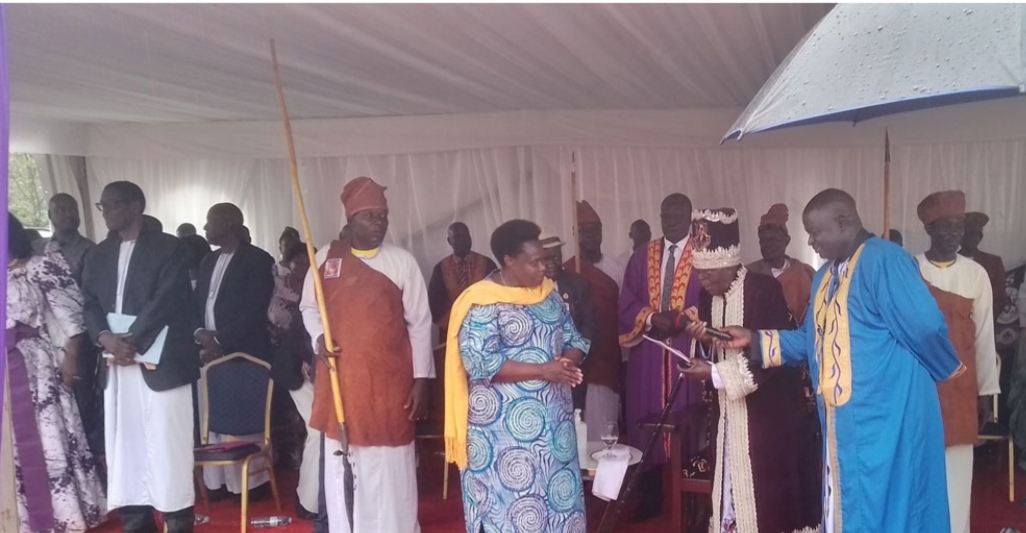
When Vice President Jessica Alupo stood in for President Museveni at the 100th birthday of Kwar Adhola Moses Stephen Owor last February, it was a clear display of government respect for the Tieng Adhola Cultural Institution (TACI). But behind the pageantry, a nagging question has refused to go away for more than 20 years: what happens when a 100-year-old king has no publicly known successor and the community has never seen its own constitution?
The Jopadhola of Tororo, 52 clans and over two million people are not alone. Across Africa, succession battles are tearing at the fabric of traditional institutions. South Africa’s Zulu throne ended up in the Constitutional Court this year. Namibia has 16 chiefdoms without recognised leaders. Uganda’s own Bunyoro kingdom needed a security lockdown in February to contain a power struggle. When cultural bodies cannot sort out their own rules, they cannot be trusted to drive development.
At the heart of the Jopadhola crisis is a simple, unanswered question: what are the rules? Mark Olinga, an elder of the Bendo clan who took part in installing Mr Owor in 1998, insists TACI began as a community-based organisation with a five-year renewable term. That term, he says, expired in 2003.
He alleges that an advisory cabinet led by the late Obbo Makola later scrapped term limits without the approval of the 52 clan heads. Whether that is true or not, one fact is undeniable: the 1998 constitution has never been made public. For an institution that receives taxpayer money and claims to speak for millions, that secrecy is a breach of basic accountability.
Independent reporting backs up these concerns. In 2009, Juma Seyyid Nyero of Uganda Radio Network reported how the ground-breaking for a Tieng Adhola palace in Nyangole village was suspended after Iteso residents claimed the land, with security chiefs warning of bloodshed. Fast-forward to April 2026, and David Ochieng of Nile Post revealed that the same palace, now budgeted at Shs5 billion had received at least Shs250 million from government and about Shs40 million from community fundraising.
What do the Jopadhola have to show? A fence and a few toilets. Cracks are already showing in the unfinished walls. Clan leader Justine Majanga wants to know where nearly Shs300 million went. Prime Minister Richard Josel Obbo promises a technical assessment, but calls for a full audit are growing louder.
A different view. Mark Olweny-Omalla, a figure named by Olinga as part of the controversial cabinet, has written his own account. In August 2024, he recalled that the idea for TACI was first floated by Roger Jassa Kwero in 1996. A meeting of 39 clan leaders at Nyasigala on 17 August 1996 resolved to form the institution, with Jassa Kwero as interim leader.
After consultations, a grand meeting of all 52 clans elected Moses Stephen Owor by consensus — not by a divisive vote. Olweny-Omalla, then a clan leader, acted as a “shuttle diplomat” to harmonise the three candidates. The coronation took place on 7 August 1999. His account does not mention term limits or any later constitutional changes. Instead, he praises Kwar Adhola Owor for championing unity, peace and development. So the dispute boils down to this: one side says the rules were changed without the clans; the other side says the institution has delivered and the rest is noise.
Here is the hard truth. Without a public constitution, without a clear succession mechanism agreed by all 52 clans, and without transparent accounts for the millions already spent, TACI cannot command the trust it needs. The repeated flare-ups, an attempt to install a rival king in 2003, a 2020 demand that “a nephew cannot inherit the throne,” a 2025 ultimatum to a member of Parliament are symptoms of the same disease: opaque governance. Each fight sucks energy away from roads, schools, clinics and jobs for the young.
Supporters of the current leadership point to real achievements: a Shs1.5 billion pledge for a girls’ university, a community radio station, and consistent recognition from State House. Vice President Alupo’s presence at the centenary was not empty ceremony. But good projects do not excuse bad governance. A strong cultural institution can build schools and be transparent at the same time. In fact, openness would only strengthen its hand.
The way forward is not complicated. First, the 52 clan heads should demand that TACI publish its constitution with all amendments included for independent review. Second, the stalled palace project should be audited from top to bottom before another shilling is raised. Third, the government should facilitate talks to help the clans agree on a succession mechanism that respects tradition but includes term limits or other checks. These are not radical ideas. They are the basics of good governance.
Mark Olinga says he wants no office and calls himself “afternoon” of his life. His goal, he says, is “better management for the future generation.” That is a goal every Japadhola should share. After more than 20 years of squabbling, and with a 100-year-old king who has no designated heir, the community deserves straight answers. Transparency is not an enemy of tradition. It is the only foundation on which a lasting palace — and a lasting people — can be built.
The author is a commentator on socio-economic and political affairs anchored on governance and development based in East Africa.



Comments
0 commentsLeave a Comment