
By Solomon Onyango
OUAGADOUGOU — Burkina Faso is pursuing an ambitious economic transformation while managing significant security concerns. The landlocked Sahel state, which recorded gold production of 94 tonnes in 2024, has launched a $64 billion National Development Plan (PND) covering 2026‑2030. Under the transitional military government, which has reduced reliance on traditional Western donors, the plan encompasses 20 major infrastructure projects. The scale is notable. The question is whether the necessary conditions can be sustained.
Several initiatives are already taking shape. The Ouagadougou–Bobo‑Dioulasso highway, a 332 km, eight‑lane corridor costing an estimated £264 million ($357 million), is a flagship endeavour. President Ibrahim Traoré has indicated it will be financed entirely from domestic resources, with CFA200 billion allocated in the 2026 budget. The Ouagadougou urban road network has seen eight projects worth $70 million inaugurated, including the Northern Ring Road. In the capital, the Burkindi Business Center – a 35‑storey tower with 14 office buildings – is intended as a regional commercial hub.
Transport extends north. The Kaya‑Dori‑Tambao railway, approximately 210 km plus a 100 km spur, is designed to unlock manganese reserves estimated at up to 100 million tonnes. The Ouagadougou‑Donsin Airport, after delays and contractual difficulties, has resumed construction following a technical audit, though its completion timeline remains uncertain.
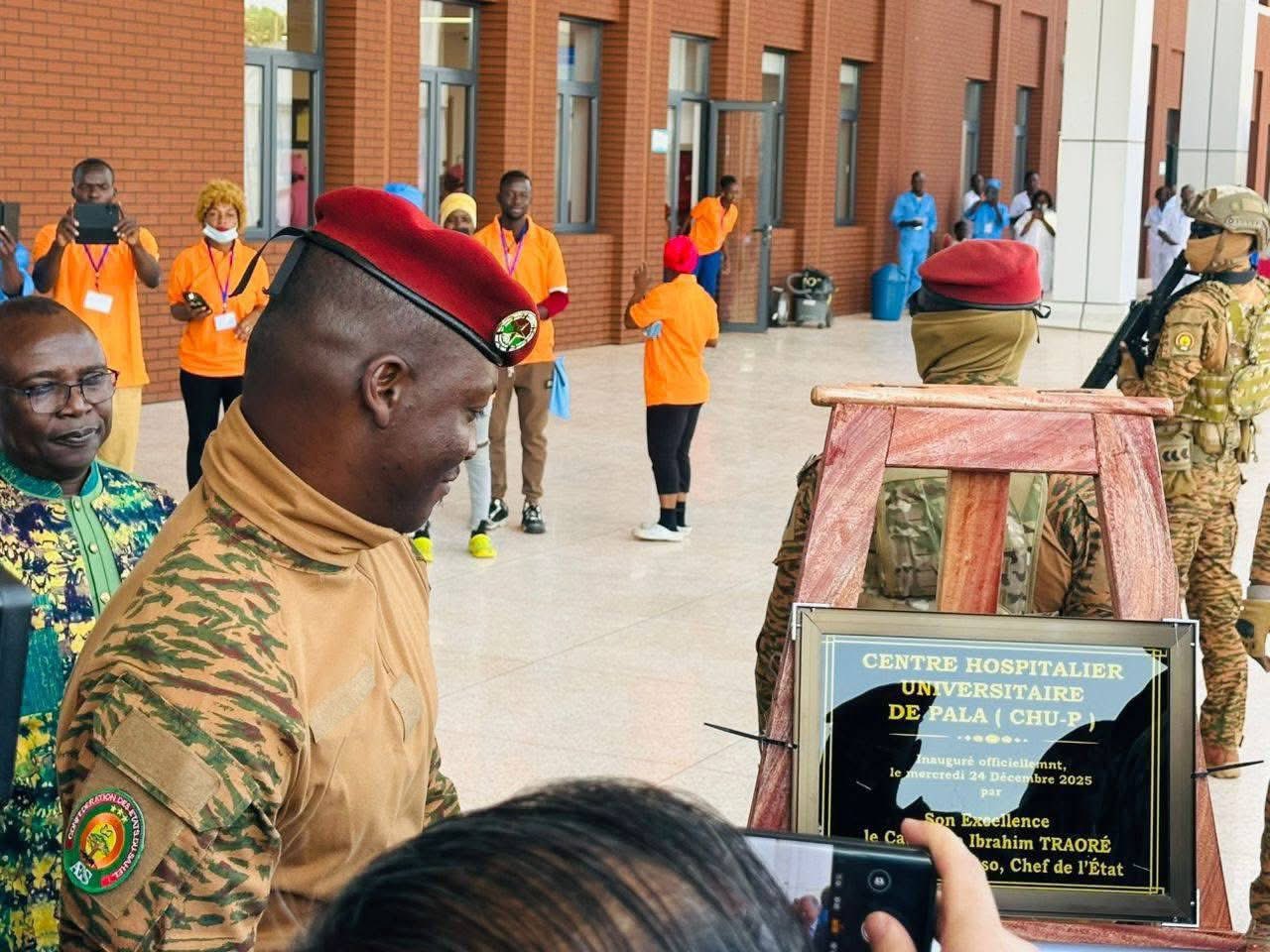
Beyond transport, the plan addresses health, education and industry. The Pala University Hospital in Bobo‑Dioulasso, a 500‑bed facility costing $125 million, was commissioned in December 2025 and includes what officials describe as the first interventional imaging suite in sub‑Saharan Africa. In higher education, 40 new amphitheatres are under construction nationwide – 15 with 1,000 seats and 25 with 500 seats – alongside laboratories and tutorial rooms at Thomas Sankara University. The FASSI detergent complex at Pabré produces 300 tonnes per day and employs over 300 permanent workers. Three new cement factories, including the Chinese‑backed CISINOB plant, have reduced local cement prices. Two solar farms, Zagtouli (50 MW) and Zano (24 MW), are operational, and the Komsilga thermal plant is undergoing a 50 MW expansion. Agricultural output reached a historic high in the 2024‑2025 season, with more than 7 million tonnes of cereals produced – 126.6% of national requirements. A $20 million maize mill is also under development.
The government’s financing strategy marks a departure from conventional models. The PND is expected to rely on 68% domestic resources and 30% external funding. Authorities have launched a “Patriotic Bond” – a diaspora bond programme – with a first phase scheduled from 6 May to 6 June 2026, targeting CFA125 billion ($224 million) at tax‑free rates of 6.75% and 6.85%. This reflects a desire to mobilise national savings rather than seek concessional loans.
Nevertheless, certain challenges merit attention. In a 2025 assessment, the International Monetary Fund observed that “weak coordination and limited technical capacity continue to undermine the efficiency and durability of public investments” in Burkina Faso. Another IMF report noted that progress in public investment management was “still insufficient”. The difficulties at the Donsin airport illustrate the risks inherent in large‑scale infrastructure delivery.
Security remains a pressing concern. Throughout 2024 and into 2025, armed groups linked to JNIM have conducted operations across the Est, Centre‑Nord and Nord regions, with numerous reported incidents. The International Crisis Group has consistently listed Burkina Faso among situations requiring close monitoring, warning that insurgent activity is “severing regional transport links”. The Kaya‑Dori‑Tambao railway traverses areas affected by insecurity. Without adequate security, transport infrastructure cannot function effectively.
Burkina Faso is not alone in pursuing development under military‑led governance. A range of experiences offers useful comparisons. Egypt, under President al‑Sisi, has mobilised military engineering for large‑scale projects such as the $15 billion New Delta agricultural initiative. However, Egypt’s fiscal capacity far exceeds that of Burkina Faso. Sudan presents a cautionary example: after the 2021 coup, civil war displaced over 12 million people, and more than 20 million face food insecurity. Ethiopia completed the Grand Ethiopian Renaissance Dam while facing internal insurgencies. Rwanda offers a parallel: President Kagame has maintained internal security while investing a $7.8 billion budget in infrastructure. Uganda, under President Museveni, continues to invest in oil‑related infrastructure while managing a long‑standing political transition. Eritrea represents a more difficult case, where prolonged conscription and the absence of electoral processes have been accompanied by very limited infrastructure development. These varied trajectories suggest that military‑led governance does not determine development outcomes by itself; what matters is the interplay of security, institutional capacity, and economic management.
Admirers of Captain Traoré have drawn comparisons to Thomas Sankara, the revolutionary leader who prioritised self‑reliance and anti‑corruption before his assassination in 1987. Sankara’s policies brought Burkina Faso close to food self‑sufficiency. Today’s government can point to a genuine grain surplus. However, the current context differs: the country faces a persistent insurgency controlling significant rural territory, whereas Sankara’s challenges were different in nature. The foundation for large‑scale investment is therefore more fragile.
In summary, the projects are not speculative. The Pala hospital is operational. The highway is under construction. The cement factories are producing. The bond is being offered to the diaspora. Military‑led development can succeed under certain conditions, as seen in Egypt and Rwanda, but it can also falter, as Sudan and Eritrea demonstrate. The key variable for Burkina Faso is whether it can improve the security situation sufficiently to protect its investments. In the Sahel, infrastructure alone cannot substitute for stability. If the insurgency is not brought under control, the 20 mega‑projects risk becoming costly undertakings that fail to deliver their intended benefits. For the moment, construction continues. Whether the security environment will permit these efforts to bear fruit remains an open question.
The Burkinabe government was invited to comment. At the time of publication, no response had been received.
The author is a commentator on socio‑economic and political affairs anchored on governance and development in East Africa.
Comments
2 commentsLeave a Comment
Abel
3 weeks, 1 day agoThis is sponsored propaganda of the west against Traole. Let Africans develop them selves freely
Agaba wicklef
3 weeks, 1 day agoWe thank the government of bakan faso for the great goal achievements setting up to develop their country onto that other governments should also ensure on their set goals as there learning sites to open their eyes widely thank you for great opportunities offered and the achievement being done to ur country